

-

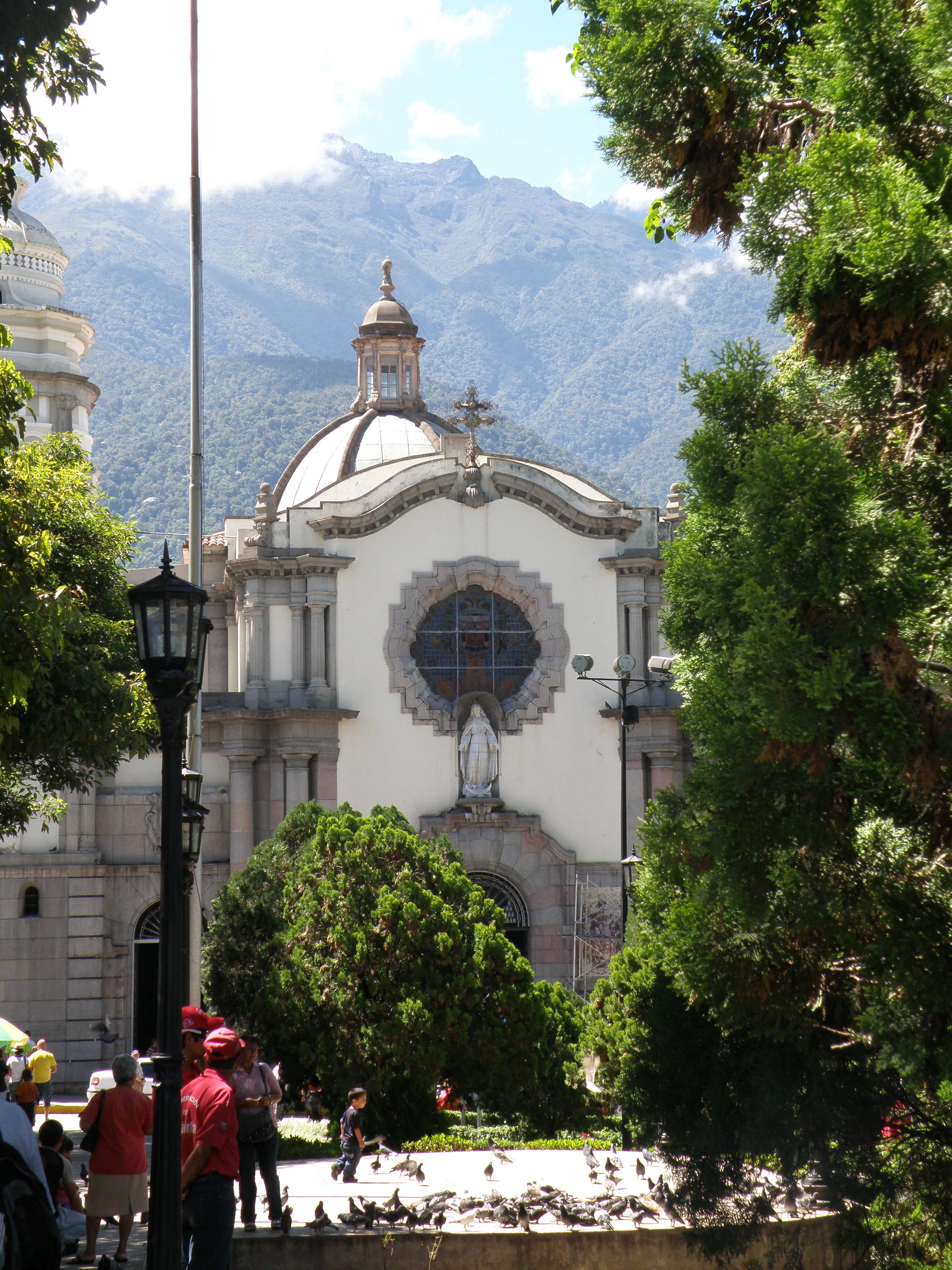
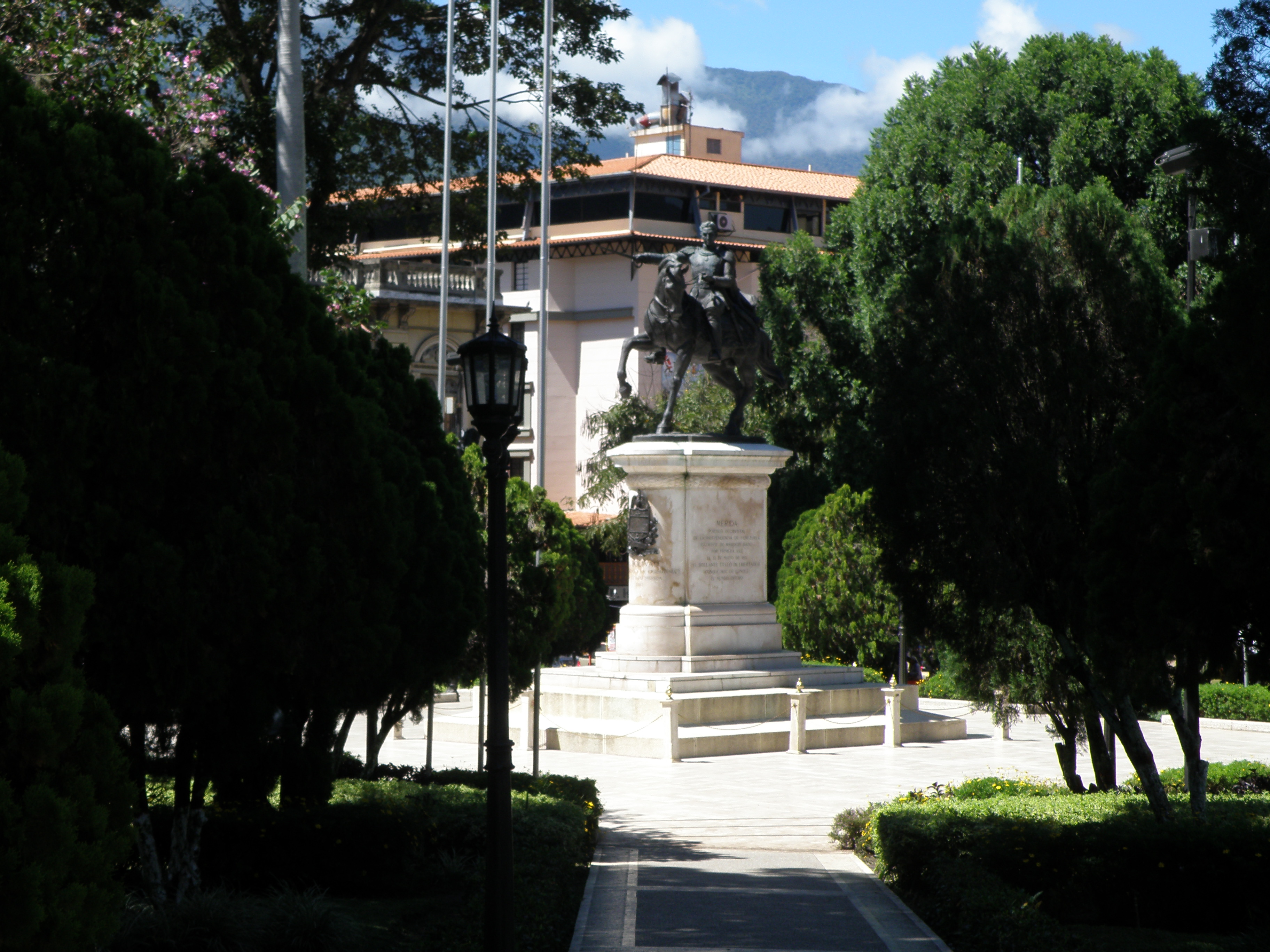
- Catedral Metropolitana, Plaza Bolivar, Merida, Venezuela








Chapter 27: Venezuela
Monday, August 23
I woke up just before 6am. Most of my belongings were damp. Even my nail clippers were rusted. I collected my guitar from reception and began the difficult trek back to Canaveral. It took a good hour. The track was almost impassable after all the rain. I was soaked through with sweat, gasping for breath, and caked in mud when I arrived at Canaveral. A young woman was setting up her craft stall for the day. I stopped to ask about transport to the park entrance. A motorcyclist stopped and used his mobile phone. He told me a moto or a minibus was on its way, which was a relief.
Another bike went past. The pillion passenger waved frantically at me. It was Claudia, beaming a big smile and a buenos dias amigo – good morning my friend! She was on her way to start another orange squashing shift. A minibus soon arrived. There were three other passengers, a French couple and an American guy. We were on our way back to civilisation. I hadn’t seen a motor car for seven days. The frantic noise of constant traffic on the main road past El Zaino was a shock to the system.
I pondered whether I could catch a bus from there to Maicao and the Venezuelan border, rather than return to Santa Marta and presumably come back along the same road. I asked at the roadside cafe while enjoying a refreshing juice. Soon after, a bus came screaming around the bend and screeched to a sudden halt. The driver’s assistant urged me to get onboard. He then grabbed all my bags and threw them into the underneath compartment.
The old charabanc had a clammy feel inside. Tired looking passengers fell back into their slumber. My rucksack was also in the compartment. It contained my wallet. At the next stop the assistant retrieved it and I paid for the fare. Now, let this be a warning to fellow travellers. A later episode of fraudulent transactions took place on my account. This bus journey could have been where it stemmed from. Who knows, but I really should have insisted on hanging on to my rucksack, as I had done on every journey.
We travelled further at such high speeds. Then we stopped to pick up a large group of lively college students. They were brandishing all the latest gadgets. Our bus arrived in Maicao in the early afternoon. Travellers were warned that this wasn’t the safest of towns. The momentum of moving diluted any worries I had though. We eventually reached the terminal where a line of collectivo taxis awaited passengers. One of the drivers approached. He pointed to an old Chevrolet which would take me to Paraguachon, and then a further two hours to Maracaibo in Venezuela.
There were two young lads sitting in the front with the driver. Another man walked up to me and asked for the fare. I then joined a young woman and her two boys sat in the back of the huge car. There were no headrests. This allowed us a clear view of the road ahead. The driver looked like Anthony Hopkins. With his raised head and screwed up, focussed expression he asked De Donda Eres? where was I from? The two lads stared back at me. Ah, Gales, he exclaimed, nodding, and glancing a knowing look to everyone in the car.
At the exit point, officials asked me several questions about my stay. They were satisfied and stamped my passport. Troops were still gathering on both sides of the border as tensions remained strained between Colombia and Venezuela. Entry formalities were quite bizarre. I waited in a queue. Then I approached a blacked-out office window. I could hear several different voices. My passport disappeared through the gap in the counter. Playing it straight and being honest kept matters simple. Short questions were answered, again to what the purpose of my visit was, and what was my profession.
After a short time, a booming voice declared, Welcome to the land of the people and President Chavez. Have a good day! prompting many laughs in the office. A hand appeared, clutching my passport, with a finger pointing to the entry stamp. I couldn’t see them, but they could see me in my Billy Bragg Tour of Wales t-shirt. It marked the 25th anniversary of the Miners’ Strike. I gathered all was well. The socialistic gesture worked! Being a British citizen also had its advantages. I didn’t have to pay any visa entry fees in South America like the North Americans did. Border crossings were rife with opportunists though. Many corrupt officials took bribes and we’ve all heard the scare stories of planted evidence.
The taxi driver tooted and waved me over. He and the passengers were all smiling. They welcomed me back and we sped off. There were so many potholes on the road it looked like bomb damage. The driver meandered all along the route to avoid them and the oncoming traffic. Sunk in the deep back seat, I viewed a landscape of litter strewn roadsides, heaps of empty plastic bottles, and the continuous oil pipeline to Maracaibo. It all looked quite ugly and tragic.
We arrived there within two hours despite a couple more stops and searches. Maracaibo is Venezuela’s second-largest city. It’s the oil industry’s nerve centre. I could have stayed there and taken a rest, but overnight buses reduce accommodation costs. I was keen to see the lightning without thunder phenomenon near the mouth of the Rio Catatumbo at Lago de Maracaibo though. Merida was a recommended base for such tours.
At the bus terminal, a young woman called me over to her desk. She asked if I needed help and promptly exchanged my pesos for bolivars. Then she arranged a bus ticket with the company she was acting on behalf of. There were others offering Merida-bound buses, but I felt reassured with the one I’d chosen thanks to the efficient and kind ways of the woman. In a new country, the priorities were safety and reaching the destinations. I didn’t want to stay too long in Venezuela. The Angel Falls were a desired destination though.
After a chicken meal in a friendly terminal cafe, I lodged myself inside an internet room. Local baseball fans were leaping about and shouting the latest scores from the USA. It was a very busy and noisy terminal. The bus was ready to depart at 10.30pm. There were tearful scenes on-board. A young mother tried to calm down her screaming toddler as they waved goodbye to the disconsolate looking father stood outside on the platform. I witnessed many similar scenes at bus stations across South America, especially at the long-distance terminals. They made me think of home but often comforted me to think how family connections strengthen us.
Tuesday, August 24
Travellers to Venezuela must do their homework and prepare. Social and political tensions were really high when I visited. Economic conditions were becoming more fragile. Banks teetered on the edge. There was high inflation and the inevitable dual currency with a rabid black market. It was a shock to the system, a massive wake-up call after an idyllic time on the Colombian north coast.
I slept for a few hours on the bus and woke up to a majestic daybreak in the cloudy, forested northeastern Andes. It all started in quite a genteel manner when I arrived in Merida. I checked the next bus connections for Ciudad Bolivar. At the time I thought little about the large queues that were lined up around the terminal for buses to Caracas. I took a taxi and marvelled at the sudden contrast from the hot and rather aggressive landscape of Monday. We were surrounded by clean streets, large trees and rolling hills as the driver played a CD of his favourite classical music.
Posada Suiza was full. The driver stayed with me as I knocked on the neighbouring door of Posada Alemania. There were spaces but I was asked to wait in the foyer because the receptionist hadn’t arrived. An elderly man was steadily fixing new light fittings around the courtyard. There was a laid-back, refined and family feel about the place. The receptionist offered me a single room at 100,000 Bolivars for one night. I settled up and booked a further two nights in a dormitory. Then I ventured out to look for breakfast and withdraw some cash.
Problems with my bank card soon arose. Banco Mercantile rejected it, as did Banco de Venezuela and Banesco. I became frantic with worry, exasperated by tiredness. After returning to Banco Mercantile I waited for my number to be called out. A bank clerk tried my card in a machine but without any success. He decided my card was faulty, saying the magnetic strip wasn’t being recognised. I had nothing else, so I phoned my bank. The line cut out twice. Then I was transferred to a call centre in Mumbai, India. I felt shattered and close to tears. What made me fall into such despair so quickly? I had to stop this crumbling defeatism immediately.
I returned to the hostel. The young manageress called Naivy listened to my situation. She was frank and firm about the matter but occupied with sorting out tour schedules. I had to stay calm. Naivy then explained my other options. The hostel family had cash wire transfer facilities set up because there were many other travellers in similar predicaments to mine. They also offered almost double the rate of exchange to that of the banks. But the time it took for a wire to come through really unsettled me. My already tight schedule was being squeezed into impossibility.
I relayed the situation in an email to my sister who immediately got on the case. Luckily, Joanna was on school holidays and had some spare time. The wire would take five working days. Later emails revealed the bank wouldn’t accept a request through my sister nor my mother to start a wire from my account. I was stuck and experiencing a bad sort of day. Perhaps I should have rested as soon as I arrived in the morning. My eagerness steered me into a brick wall which left me mentally battered and bruised. I was so wound up and increasingly snappy.
I had $30 left, which at the hostel’s black-market rates, equated to about 230,000 Bolivars. It gave me just about enough for two days accommodation and food. I took lunch, then slept for the afternoon. It helped. I called Mam from an internet cafe phone booth. Our conversation really eased my worries. Mam reassured me that we’d work something out. I really wasn’t sure whether I’d nominated Mam as a third-party authorisation. I did remember speaking to my bank back in January about travel arrangements and accessing cash. Mam’s words had calmed me down though. I later took a shower and returned to bed and fell into a deep sleep.
Wednesday, August 25
The guest house offered a decent breakfast. Ham, eggs, cheese, fresh coffee, and mango juice. Now, this was a far better start to the day. I reflected on a lesson hastily learnt. Always check the economic situation in Venezuela, or any other country for that matter, not just the political. US dollars were the quickest way to exchange cash. They were readily welcomed by all Venezuelans, but carrying a large wad of notes could be quite risky. Pre-arranging a cash wire transfer was another option.
After breakfast I visited the cathedral. I lit a candle then whispered a prayer while sat on a bench in front of the altar. My introduction to Venezuela had certainly jolted me out of my Colombian coast reverie. I’d previously read a little about long term poverty in Venezuela. So much petrol wealth, somehow, failed to filter deeper into society. The petrol poured out of Venezuela and so many imports flowed back in to fuel domestic consumption. There was no self-reliant or creative drive in the economy, just an over-reliance on fossil fuels.
Strange clouds banked up above Merida and let out their aggression in a huge storm over the higher hills and valleys. Merida reminded me of a cleaner version of Patagonia’s El Bolson. I moved into the biggest dormitory and took a lower bed. I sat there thinking. What could I do next, apart from taking to the road in a land I wasn’t so sure about? There were reports of volatility throughout the country. Caracas had, in the previous year, been the murder capital of the world. There were so many military checkpoints as well. The Lonely Planet described the police as being less than trustworthy and reckoned President Hugo Chavez was whipping up a national paranoia about foreign spies. To be honest though, weren’t the travel experts whipping up fear about the internal affairs of a deeply split country? Was it that deeply divided?
I had to admit there was a tension. People either loved Chavez and his socialist politics, or they hated him. The business community, especially the powerful corporations, hated him. Here was a man who, when seeing his fellow people being murdered by the state, turned the army against the oppressive rulers. The problem evolved into Chavez’s questionable treatment of political opponents and his undignified relationship with big business. Attempts to reverse decades of social decline were met with a cold response from the people with money. There needed to be far more cooperation to get the domestic economy rolling along in Venezuela. All the ingredients were there. The people I’d already met were beautiful, caring, good-natured characters and the landscape had an abundance of natural beauty and resources.
Good news came from home. My sister Joanna emailed to say Mam was offering to help. I had the guest house owner’s Santander bank details in Asturias, Northern Spain to arrange a cash wire. Joanna emailed back to say Mam was offering to carry out a cash wire transfer from her account. I carefully typed out the details and Joanna promised to get on the case straight away. Mam was helping me out big time. I promised to pay her back as quickly as possible. Our Mothers really are the miracle workers of the world!
Naivy offered little response when I told her I could arrange a transfer. It seemed like she was handing out those little bank detail papers every day. She told me it would take at least three working days. I took my mind away. I went out and walked down to the Teleferico terminal. The Teleferico was the world’s highest and longest cable car system. It drew in many visitors to Merida. I decided on a visit after hearing the great descriptions about the town’s outdoor pursuits.
I arrived at a deserted looking Teleferico. An embarrassed looking lady informed me that the cable car had been out of action for two years. I asked why. When would it reopen? The lady replied that there were mechanical faults, and that it all represented the malfunctioning state of Venezuela! I felt her frustration. Merida’s friendly and sociable reputation for being La Ciudad de los Caballeros – The City of Gentlemen meant little if people of different faiths couldn’t work together.
Thursday, August 26
Another good rest eased my nerves. I asked Naivy how much £200 would be in Bolivars. She replied that 200 Euros would roughly equate to 1,800,000 Bolivars. I had Euro coins to exchange but she could only accept notes. The dormitory bed cost 36,000 Bolivars a night. I had no money left for food, but Naivy promised to talk to the owner to lend me 200,000.
There was an increasing sense of feeling trapped. I went away and read for a while, then ventured out to an internet cafe. There was good news from my sister and Mam regarding the cash wire. A confirmation document was attached to an email. I later showed it to the hostel owner. With a stern frown he pointed out that there was no bank signature on it.
I felt a sharp, tingling pain in my side. It was a flare up of the shingles I first experienced a decade ago. I really wanted to shake out of this negative state and went back out to buy some shaving cream, razors, and deodorant. I later freshened up, put my sandals on and strolled around the hostel courtyard before writing away long into the evening.
There was a cold atmosphere in the hostel. I wasn’t alone in being made to feel unwelcome. It wasn’t personal, but a totally different vibe to all the places I’d stayed in across South America. The owner was more focussed on the tour operations. He geared up the staff with the same attitude. They viewed the guests as a slight distraction maybe, and never showed too much concern for them. Sweet and soothing sounds of the French language later drifted about in the courtyard as night descended. The melodic conversations calmed me down and I soon fell asleep.
Friday, August 27
After another fine sleep I wandered into the courtyard for breakfast. There was a guy sitting at the opposite end of the long table. After a short, silent interlude, where I almost meditated and gathered my thoughts for the day ahead, I went over to introduce myself. He was Simon from Stuttgart, Germany. Simon was on a six-week break over the summer holidays. He was starting as a full-time English teacher in September. We had a good chat. He assured me I wasn’t being stupid to have not brought enough dollars into the country.
Simon also found Venezuela to be a different experience. He took a more philosophical approach to the challenges he’d faced thus far. This included being held up at knife point in a Caracas bus station in the middle of the day! He said it was obviously very scary, but they were young lads. He quickly reacted by just turning around and walking away, and nothing further happened. We agreed there was a current of disagreement flowing through the country. But Simon assured me the people he’d met so far had been tremendously generous to him. We agreed to hook up for the day.
Simon was a decent guitar player. He played some of his English language songs and I played my Welsh song called Gwybodaeth (Knowledge). I recalled its success in an Eisteddfod for Welsh Learners competition in 2007. Our music must have lightened the atmosphere somewhat. The elder gentleman of the family came into the dormitory and listened. He smiled and applauded us. That was a really nice gesture. I looked up to him, expressing thanks. I just wanted peace not coldness.
Simon and I ventured along the Viaducto Campo Elias over the Rio Albarregas. Crossing the bridge, we saw the bizarre sight of a load of dumped police vehicles close to the river’s edge. What was all that about? We ambled on down Avenidas Las Americas to the Mercado Principal. It was a rather commercial arcade. The craft shops sold lots of ornaments. We returned to the hostel, finding a cheap lunch along the way.
Simon had met some local women during a night out. He received a message on his mobile phone asking him to meet up with them. However, according to Simon, the locals were notoriously bad timekeepers. Indeed, we all met up hours later than the intended time back in the hostel courtyard. We enjoyed some beers and tried to plan a trek for the following day. I gathered how much these youngsters wanted to leave Venezuela. They just wanted to be elsewhere. It was quite sad to hear such sentiment and feelings of hopelessness.
There were lots of complaints about the burdens of bureaucracy. Many youngsters from middle-class families wanted to taste life in Europe, either on a university degree course, travelling or working. I just listened and seemed to hear the grass is greener on the other side type of talk. What with the economic problems in Greece and Spain, was it sensible to transfer one’s whole life to the other side of the world? I fully understood their desires though. Venezuelan life seemed to be too static for them. Travelling, and learning about new countries is why I found myself where I was in Merida.
I wanted to hear about the deep issues with Hugo Chavez’s presidency though. Everybody I asked never seemed to give a straight answer. Was there a fear to be too open about such matters? The economic effects on the people were more evident. Inflation continued to run at high levels and there was a massive black market in currency exchange for Euros and US dollars. Citizens could only withdraw a maximum of 1,000,000 Bolivars each day.
The evening rain became heavier. I decided I wouldn’t be joining the weekend trek. I was in a more positive frame of mind though. It had been a much better day, thanks to the good company. I later checked my emails. Joanna had sent the wire transfer document complete with signature. Progress at last, and I took the information to reception. I drank a late beer and began thinking about the journey to reach the Brazilian border.
Saturday, August 28
A lad called Flo, from Dusseldorf, Germany arrived in the dormitory. He could tell there was a cloud still hanging over me. My shingles had cleared somewhat but everything seemed delayed in Merida. The people were frustrated or resigned in their outlook. It was quite contagious. Rather than waiting about, I needed to occupy myself.
My camera’s picture card reader started messing up again. The lovely people at Sonido International CA helped me out. They dismissed the card reader as a bit of junk and recommended the internet café shop next door. There was a man there who could really help. He then guided me to a gadget shop further down Avenida 3 Independencia. A kind couple in the gadget shop struggled to get their computer to read the card. They eventually succeeded and copied my pictures onto a disc. They reckoned the attachment for the micro-SD card was faulty. I returned to Sonido after lunch and bought a new Iogear card reader, micro-SD socket included, for 125,000 Bolivars. They also gave me a free Olympus attachment for the micro-SD card. It took me several hours to accomplish this task but at least my Spanish language skills were put to good use!
To cool down and relax, I later visited the Heladeria Coromoto. It held the Guinness Book of Records title for the largest number of ice cream flavours in the world. There were 900 different types all listed on a large wall. A distinguished looking gentleman ran the joint. He was seated behind the counter signing autographs. Like an A-list celebrity he acknowledged the customers, mainly a big crowd of teenagers. The place was packed but I soon found my way to the front and chose a rice and coconut flavoured ice cream. It tasted really nice.
Simon had been for a different kind of retreat with his new Venezuelan friends and a French guy who was also staying in our dormitory. They returned during the evening. Simon had stomach pains and wasn’t feeling at all well. The retreat wasn’t what he’d expected and the storms over Merida were even worse there. He was in a bit of a race against time and needed to be in Caracas on Wednesday to catch his flight home to Germany for a friend’s wedding on Saturday. We chatted away over a couple of beers. Simon was a generous, liberal spirit who shared a happy enthusiasm for life.
I was nearing the completion of my Colombia write-up. Just a couple more photographs to attach and it was ready to send through to Daily Post Wales. My creative juices were really flowing after my travels in Colombia. Even the current experience in Venezuela was becoming more positive by the day.
Sunday, August 29
It was a lovely, sunny morning. In the courtyard shade I sat with a friendly couple from Stuttgart, Rebecca and Henri. There was a fresh feel to the day. It invited optimism. I went off around the town taking some photographs. The Sunday streets were so quiet. Merida was chilling out. From the Parque Las Heroinas to the Plaza Bolivar there were great views. The panoramic vista from Parque de Las Cinco Republicas was simply breath-taking. Many shops were closed but I found an internet café. Then I rejoined Simon, Rebecca and Henri for an exciting afternoon at the football.
We took a taxi to the Estadio Olimpico Metropolitano de Merida. The route took us through the wealthy neighbourhoods. So much property was protected with expensive electric fencing and security gates. Were the rich in that much fear? Obviously so. Day by day, I was becoming aware of the glaring wealth disparities in this country. Government billboard posters were everywhere on the main thoroughfare out of Merida. They extolled the virtues of being a good citizen from cradle to grave.
The football stadium had a 42,000 capacity. It was a very modern, impressive structure and was built as one of the venues for the 2007 Copa America. Two sides were covered, leaving the ends behind the goals and athletics track open to the elements. It was all nestled neatly in a stunning rural location within the city’s southern outskirts.
We queued up and shared some good-natured banter with Estudiantes de Merida supporters. They were eager to see their side put one over on the visitors from Caracas, Atletico Venezuela. We paid just 25,000 Bolivars, about £3, to sit in any seat we liked in the main stand with the home supporters. There were about 5,000 spectators inside the ground when the game kicked off. About two coach loads of Atletico fans were behind one goal. Many of their scarves and large banners were draped over the seats and barriers. They had a small band trying to whip up the support with their drums and whistles. They succeeded in goading the home crowd to deliver the first of many renditions of E….E….E….Estudiantes. The tannoy announcer then got up to speed and started repeating the same beating tune. At five minutes to four the on-field weightlifting contest between the home team players ceased. Lifting weights seemed an odd way to warm up but the players needed to be pumped up for the action to follow.
Both teams re-emerged. The refereeing officials entered the arena, protected by riot police brandishing big shields. Then it all went solemn for three minutes. The spectators and all participants turned towards the far side of the pitch and sang the Venezuelan National Anthem. The small crowd made plenty of noise, and a good-humoured one. The home side took complete control in the first half an hour. There were good individual skills on display. Three Estudiantes goals came in quick succession. The first came courtesy of a goalkeeping error, the second a tap in. The third was a great team goal, built on some fluent passing and moving. Atletico sprung to life and hit the crossbar twice in the latter stages of the first half.
The interval provided further entertainment. A local radio station’s outside broadcasting team conducted a competition to see which supporters could shout the longest gooooaaaalllll! A young lad in a Manchester United shirt had the biggest lungs of the lot. He was rewarded with Venezuelan and Spanish national football shirts. There were loads of supporters in replica United, Real Madrid, Barcelona, or Bayern Munich shirts. The colourful spectacle of people enjoying the moment highlighted a physical absence of advertisement hoardings around the ground. In so many stadiums around the world they dazzle us with the latest products in sponsorship of the beautiful game. It was quite different here, but it didn’t offend me at all. I think it just reflected a little of what was going on in Venezuela’s politics.
The happy atmosphere grew in the second half as the home supporters were treated to the best goal of the match. It all ended 4-0 to Estudiantes de Merida. We descended the dark, spiralling exit onto a side street. However, there was a proper commotion outside. What on earth was happening? There was a herd of cows on the scene. How bizarre, but also how dangerous could this become? The cows went on the rampage bumping into vehicles. Luckily, they vanished as quickly as they’d appeared, and no one was hurt. I can’t remember anything like this occurring in our rural based Llandyrnog and District Summer League back in North Wales. There used to be a couple of shire horses that ran laps of the field when Llanbedr were playing at home though!
To escape the crowded congestion, we found some lads in a random pick-up truck. They invited us to jump into the back trailer. A home supporter called Williem joined us. On the swift journey back up town Williem’s jubilant mood entertained us. He poured out phrases of philosophy and reckoned if we all gave away some of our salary to charity, we’d get four times as much money back in the long run.
We reached the centre of Merida in quick time and jumped out from the back. The others went to try out the big ice cream parlour, not before Williem asked us all for money. He then hopped off for a few more beers. Walking up Avenida 3 soon after I spotted him once again, shouting drunken words at another man across the street. It was an entertaining evening in Venezuela at long last. I’d watched some quality football, players warming up with a weightlifting contest, referees entering the pitch shielded by riot police and then cows going on the rampage outside the stadium afterwards. It was a bit different to your usual British football match experience!
Monday, August 30
We were talking to an extremely pleasant lad from Marseilles. Patrick had been on a long trek arranged by the guest house. He was there to collect his bags and politely asked if he could go into the communal kitchen to make a cup of tea. You are no longer a guest, so no way! replied an insulted looking Naivy. Simon was speechless with surprise. Why were these hosts being so indifferent?
My Mother’s welcome £200 wire transfer had come through, the owner briefly told me. He sat in reception looking stern faced as new visitors entered. Naivy seemed to be doing too much of the work. There was multi-tasking. Then there was being overloaded with someone else’s tasks. Despite the constant interruptions, she calmly calculated the exchange for me. I had 1,100,000 Bolivars remaining to reach the Brazilian border. She happened to ask where I was going next. I told her my plans and she exclaimed that I need not go to Valencia to travel to Ciudad Bolivar. There were plenty of buses direct to Barinas, six hours away to the southeast, where regular night-time buses then went on to Ciudad Bolivar. I was so grateful that Naivy had asked me. It would reduce my journey to reach the Brazilian border by about a thousand kilometres.
I had lunch with Simon. He was concerned about something. There were reports of there being no bus tickets left for Caracas. People had to purchase their tickets on the day of travel. That explained the large terminal queue so early in the morning when I first arrived in Merida. However, there was another way for Simon. He could travel with me to Barinas and from there up to Caracas. It would take him longer, but bus seat spaces were almost guaranteed. We returned from lunch, but the hosts were having theirs. They would not be disturbed by Simon wanting to collect his luggage from the reception office! We eventually got going and took a taxi. A Barinas-bound bus was just leaving when we arrived at the terminal but another one soon began filling up with more passengers. It was an hourly service.
I was looking forward to putting an unsettling episode behind me. The interruptions, delays, malfunctions, and misinformation were some of the lows to go with the highs of travelling. As the bus veered out of Merida I was thinking about home. It was the August Bank Holiday. My thoughts turned to Brian, my godfather, who had been rushed to Walton Hospital in Liverpool. I needed to phone home for an update.
Simon and I talked a lot about music as the bus radio played constant South American popular tunes and folklorica classics. There were regular songs by the highly successful Mexican band called Mana. They sounded alright. Simon loved them. Mana were not only big in the Spanish speaking world but also in parts of Europe and Australia. They’ve been described as the most influential Spanish-language rock band of all time. Simon wasn’t so keen on folk music, but I loved some of the stuff being played, especially the wild and dramatic Mexican tunes.
Our bus climbed ever higher into the misty mountains. We witnessed some quite stunning scenery. Old, remote villages were dotted here and there. Down beyond the high passes, groups of young ramblers boarded the bus. It was dark by the time we reached Barinas. The terminal was hot and chaotic. People rushed with their heavy belongings in between tightly parked buses. Within moments Simon was in luck with a space on a nearby bus to Caracas. I, meanwhile, struggled to see any bus for Ciudad Bolivar. I helped Simon get on board his bus. We embraced, wished each other good luck and then I went into the terminal building to enquire further.
I quickly gathered there were no spaces left on the buses that night. According to one stern faced lady behind a counter, there were none till Saturday. I turned my attention to another kiosk where the ticket operators expressed apologies. My face dropped but I quickly composed myself. I earnestly explained that I really needed to get to Brazil for family reasons. Then Simon appeared again. He helped me with the Spanish negotiations. The staff behind the counter muttered to each other. They told me to stick around as there was always a possibility of passengers cancelling their trip or just not turning up. I briefly thought about staying in a Barinas hotel but decided to wait it out. If there was no space on the midnight bus, I’d at least be at the front of the queue the next morning for a following night’s journey. Tiredness was creeping up on me, however. I just didn’t feel easy with all my stuff either. Perhaps I was carrying too much.
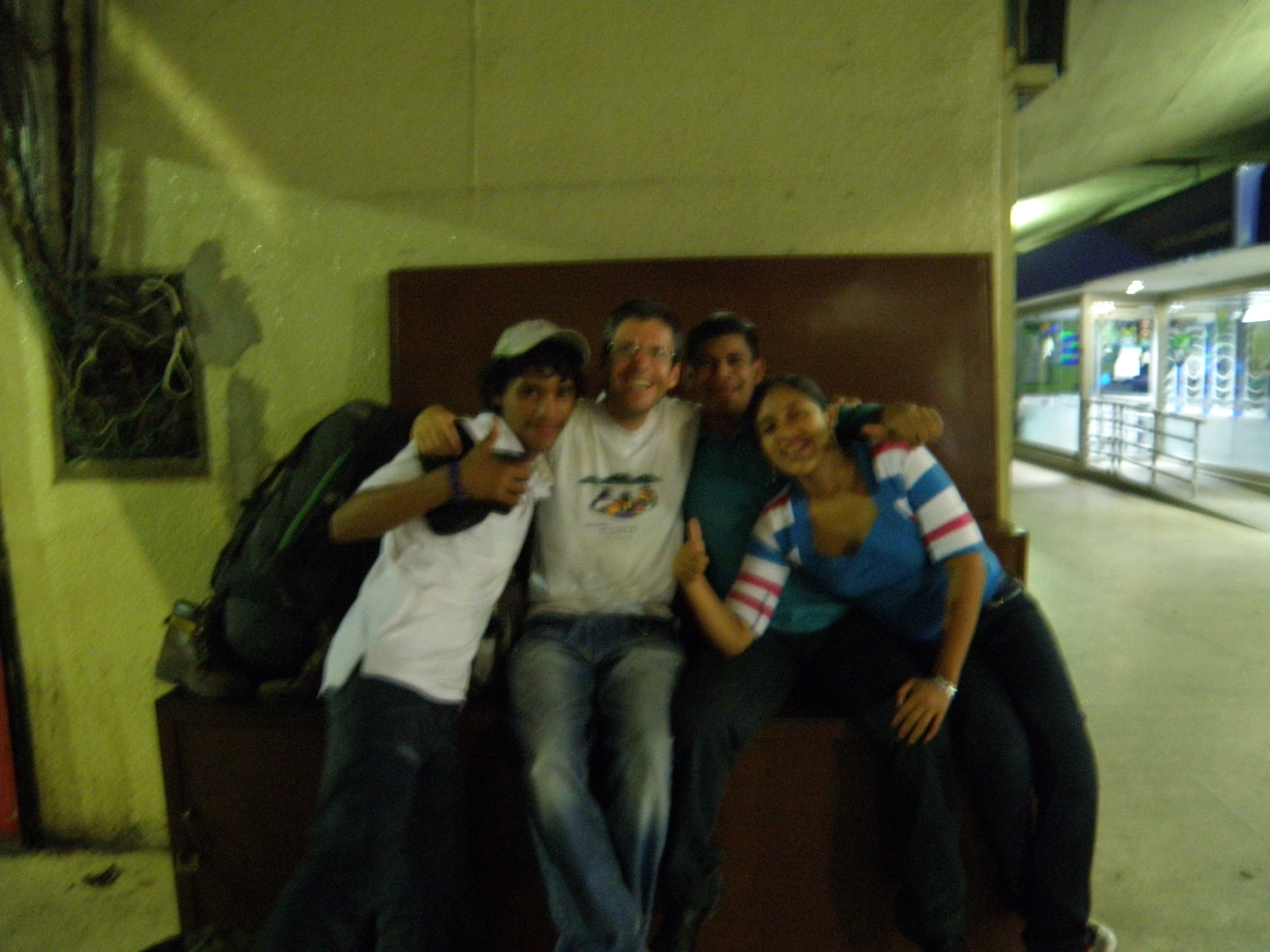
A short while after, a young lad approached me in the terminal shop. He spoke to me in broken English. I immediately responded and realised he was a good one. His name was Daniel and we got talking. His brother and his friends joined us. They were all with Daniel’s mother. She was carefully watching me from her bench seat. They were a family of evangelists. Daniel, Jason and Frances were determined to lift my spirits. They reassured me I’d be getting on a bus at midnight. They were also travelling to Ciudad Bolivar. The mother came to sit with us. I showed them my guitar. The mood lightened further, and we played some tunes together. I conversed in Spanish, as Simon urged me to do before he had to get back on his bus.
As the hour approached, we waited outside on the platform. The young ones were saying no preoccupado – no worries. When a bus did eventually arrive at 1am, Daniel disappeared. Shortly afterwards he reappeared and called me over. The bus driver told me to stand aside as he checked in the final few passengers. There were no spaces, interjected the terminal clerk, but the driver nodded to Daniel to keep me at one side. When the clerk went back inside the terminal, the driver quickly asked me for 150,000 Bolivars! I thanked Daniel enormously and presented him with my Wales bobble hat as a memento.
On board the double-decker bus I soon realised there were no seats available. Some of the passengers teasingly reminded me, so I was left to take as much of the aisle space as I wanted. The driver of the Expresos Los Llanos Occidente bus then told me to stick around the bottom of the steps behind the driver’s door. It was near to the toilet but crucially out of view when passing the military and police checkpoints.
Tuesday, August 31
Daniel and his family were lovely examples of the Venezuelan warmth and welcome. They cancelled out all the negative experiences in the country. The people were alright, but there was a power struggle happening in their society. There needed to be more trust to make this a properly progressive country.
An interior alarm kept going off on the top deck throughout the first part of the journey to Ciudad Bolivar. The passengers became understandably annoyed. A big chap came down the stairs. He asked me to knock on the driver’s door to grab his attention. I already had, so he tried as well, unsuccessfully. He introduced himself. His name was Max. He stayed with me for a while, and we chatted. Max had a North American father and spoke good English. He was a devout Catholic and spoke with great spirit about a convention he’d spent the weekend at.
I later managed to sleep for a while, thanks to an inflatable neck cushion. At 7am more passengers were dropped off. There was space on the lower deck at the back. Most people were stretched out and sleeping. More spaces became available. I sat next to a young man called Jonathan. His wife and young daughter were sitting on the opposite seat. They were extremely friendly. Jonathan offered me a sandwich. I politely declined as an early hour nausea and tiredness overwhelmed.
At Valle de La Pascua we had a lunch stop. Other buses arrived. In amongst the disembarking crowds, I spotted a Welsh bobble hat and Daniel’s big smile! He rushed over to greet me and ask how I was. Later, back on the bus, an attractive young woman seated in front of me was getting off at El Tigre. She suddenly turned around to say a happy goodbye and wished me good luck for the rest of my travels. There were a few tight spots in Venezuela but lots of similar friendly exchanges confirmed my belief that there’s an innate goodness out there. The happier conversations on the bus really lifted my spirits. It was mid-afternoon. The bus crossed over the Rio Orinoco, and Ciudad Bolivar came into view.
Another Expresos Los Llanos bus was leaving at 6.30pm for the Gran Sabana border town of Santa Elena De Uairen. I paid 97,000 Bolivars for my ticket then had time to eat a late afternoon meal and check my emails. Like so many bus terminals, Ciudad Bolivar’s was a non-descript traffic island. They bore little reflection on the town or city they were in. They were hectic, transit places in South America and certainly not for the faint-hearted. In the hectic air of people smells mingling with burning meat and cigar smoke, I craved for the air-conditioned interior of the next bus. We experienced a steady start but there were people on the bus who weren’t meant to be there for some reason. The driver’s assistant escorted them off before we set off properly for Ciudad Guayana.
Wednesday, September 1
It was a night of frequent patrol stops on the journey due south to Santa Elena. I was on the top deck, near the front, sitting on the left. Whenever the bus came to a slowing stop, anxiety took over the passengers. Five times we were stopped for a 12-hour journey which became 14. My neck cushion helped me to sink into intermittent sleeps though. An overhead compartment shutter kept opening and rattling away so I found some paper to wedge it tightly shut.
On the second to last checkpoint a military guy came onto the bus shouting for everybody to wake up, exit the bus and form two separate queues for men and women. These scenarios always chilled me to the bone. Everybody’s expressions sank. There was little chatter, just a quiet reserved hope that it would all move along quite quickly, and we’d be off again in a matter of minutes. However, on this particular stop the baggage compartment was emptied, and we were all told to retrieve our belongings.
When my turn came to empty my bags the lead officer checked my passport and told me to step aside. I was taken into a nearby station where I had to strip down to my underpants and be searched. I felt cold despite the night being warm and clammy. Anything could have happened. I was keen to reach Brazil now. From my passport the officers could see I’d travelled some distance in a short space of time. They asked why I wasn’t staying around. It all passed without incident though. The soldiers immediately relaxed their manner and expressed gratitude for my patience. The lead officer then walked up to me and firmly shook my hand. He wished me luck and said Goodbye Sir, have a good morning.
The sun rose over the high, grassy plains of the Gran Sabana (Great Savanna). The high plateau included the massive table mountain of Roraima, part of the lost world of Venezuela. It looked a stunning part of the world, but another stop and search soon occurred. It passed without any further fuss though. When we reached Santa Elena at about 9am I felt a great psychological weight lifting from me. I carried my belongings into the terminal. It was the final month of my trip. Venezuela had tested my resolve. I was mentally unprepared for the country but also fascinated and intrigued.
I remained in the terminal for a short while and sat with one of the other bus passengers while eating a light breakfast. His name was Steffan, originally from France, but living out in French Guyana for the last four years. He’d been on a trekking adventure for the week and was heading back northeast. The early morning sun was already baking the ground. I asked for travel advice in the terminal’s tourism office. There were guided trips to the region including one deep into the Parque Nacional Canaima and Angel Falls (Salto Angel). It was the world’s highest waterfall at 979 metres, 16 times higher than Niagara Falls. It was also Venezuela’s number one tourist attraction. I’d seriously considered visiting it until the hold-up in Merida. It wasn’t an easy place to get to though.
Within half an hour, I took a taxi to the border for 50,000 Bolivars. We were stopped and my bags were searched again. The driver then took me to where I thought was the exit point, but it turned out to be a small bus terminal. I told him I needed to go through immigration, so he drove me back the two kilometres where my passport was stamped. At least I didn’t have to pay the infrequent tax for leaving Venezuela.
We reached the Brazil entry point. A stern looking policeman took care of formalities. He asked me how long I wanted to stay in Brazil. I replied not more than a month. I then presented my yellow fever card which he barely acknowledged. However, they can turn back travellers who were without the card. The driver then asked for another 10,000 Bolivars. I happily gave it to him as this was another free entry into a new country.
A collectivo taxi driver had space for one more. I exchanged my Bolivars for Reais (R$) and off we went on a three-hour journey down the smoother Route 174 to Boa Vista. I’d made it through a tiresome 24 hours and now, underneath the hot sun, I was moving on through the ever-dramatic countryside. The passengers were speaking Portuguese and I smiled about this latest communication challenge. Rodoviaria (bus terminal) was the first word I needed to remember apart from the greeting formalities.
Eucatar had an overnight bus leaving at 6pm. The ticket cost 100 R$ and left me with no cash. The terminal was undergoing major refurbishment and the cash machines weren’t operating. I asked for directions to the nearest bank. There was a Banco do Brasil branch and a HSBC kiosk across the road. Armed guards were doing something in the kiosk and a huge queue formed outside the bank. I thought about going further into the town. The dusty streets were desolate, so I turned back.
The HSBC machine refused to accept my card, with a message flashing up about the magnetic strip. My heart sank. I began to wonder if my card was indeed falling to bits. After waiting an hour in the Banco do Brasil queue, I finally stepped up to the machine. It worked the third time of trying and I managed to withdraw 400 R$. It was a massive relief, but I really needed to contact my bank back at home.
In the terminal bathroom I freshened up and changed into clean clothes. The cool Eucatur bus left the mud yard station bang on 6pm. The half-empty bus took to the open road. A stunning sunset over the western plains promised good nights and days ahead in Brazil.

 Reading English, Hearing Spanish